Practice coaching on AI-simulated clients.
Get structured formative feedback.
You didn't learn music by reading scores. You won't master coaching by reading theory. Coach's Room gives you the practice: real clients, real resistance, real contexts — and a Strength–Stretch report after every session, referencing the International Coaching Federation (ICF) Core Competencies.
One free practice arc every month — a chemistry call and a coaching session with the same client.
Meet the clients
Four clients, four very different coaching problems. Pick one and run the arc.

Claire
The empty nester who wants her life back — and wants it scheduled
A recently retired headteacher with a list as long as her arm of things she 'should' do — asking for a plan when the real work is finding the want underneath the shoulds. The trap: a goals session feels like success.
Their ask
“I want a plan — projects, structure, something to aim at. I've done the marathon, I've joined the choir, I've booked the Italian course. Nothing sticks. Can we build me a proper list of goals I'll actually keep?”

Elias
The founder-CEO the board sent
Built the firm from nothing; the board now calls him the bottleneck. Sent, not searching.
Their ask
“The board says I'm the bottleneck — 'in the detail, out of the strategic space,' their words. If coaching gets them off my back, fine. Tell me what the playbook is.”

Tessa
The Verdict She Keeps Trying to Pass
She's competent, collected, and completely certain the room is grading her on a test nobody has written down — so she's memorised every presence article on the internet instead, and arrives asking for tips.
Their ask
“My sponsor says the only thing between me and the MD list is gravitas. The board meeting's in March. I want to walk into that room the way I walk into a bid review — knowing I'll land it.”

Sonya
The Guarded Executive Behind the Wall
She says her new officemate is auditing her every move. The merger says something else is watching her too.
Their ask
“I need practical strategies to stop my new officemate, Julian, from micromanaging my client accounts and forcing unnecessary Apex bureaucracy onto my day, so I can focus on doing my job.”
How it works
Pick a client and difficulty
Choose a simulated client and a calibration bar — ACC, PCC, or MCC.
Run the arc
Chemistry call, then the coaching session, by voice or text.
Get your Strength–Stretch report
Two strengths, one stretch, quote-anchored to your own words.
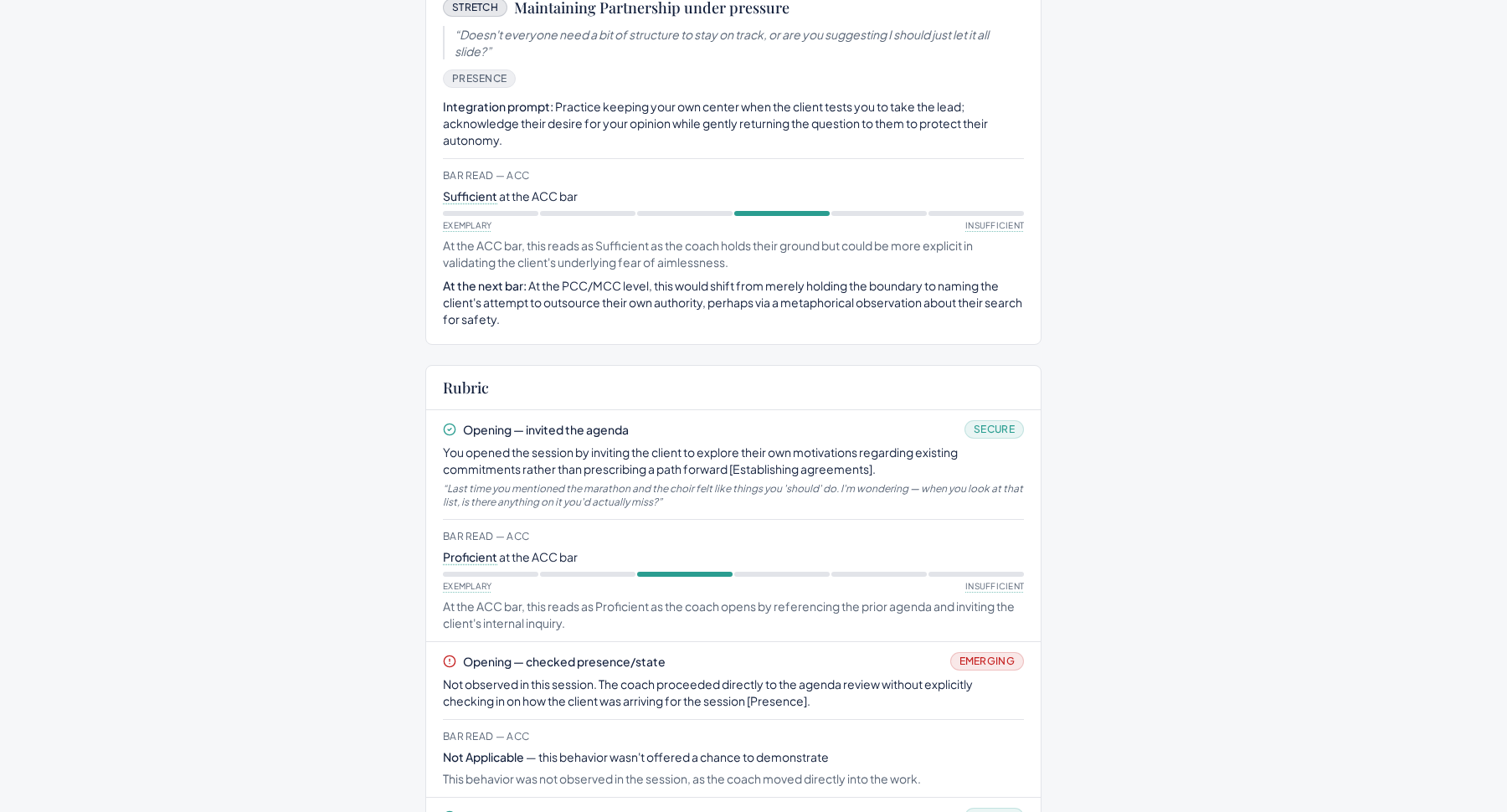
From a real practice session — quotes are your own words.
Practice was limited to whoever would let you coach them.
Any client, any difficulty, any hour.
Feedback depended on who was watching.
Every session read against the same competencies.
The problem isn't talent. It's practice.
Most coach training stops at theory. But coaching is a performance skill, like music. The only way to develop your own coaching voice is to coach — different clients, different topics, different moments of resistance — until the craft becomes yours.
Coach's Room is the practice room. Pick a client, pick a calibration bar, run the session. The more different clients you coach, the freer your own style becomes.
Theory made you a student. Practice makes you a coach.
68%
of major organisations require their coaches to hold an accreditation.
— 6th Ridler Report (2016), Ridler & Co.
83%
of organisations plan to expand managers using coaching skills. 33% provide accredited training.
— Building a Coaching Culture (2018), ICF & Human Capital Institute.
Sources cited with attribution. Coach's Room is not affiliated with or endorsed by ICF.
Why not just roleplay with ChatGPT?
Generic AI can improvise a client. That's the point — it improvises. A practice tool needs to be built for coaching practice, and hold you to a standard.
ChatGPT roleplay
Coach's Room
The client
Plays whatever you prompt, drifts to please you
Personas with their own history, topic, and boundaries — they resist when a real client would
Difficulty
You control the scene, so you unconsciously keep it easy
Calibrated bars from ACC to MCC — you pick the stretch, the persona holds it
Feedback
General encouragement, no standard
Strength–Stretch report with quotes from your own session, referencing the ICF Core Competencies
Consistency
A new chat forgets yesterday
Each persona carries memory across a full two-session arc
Your data
You don't know where it goes
UK-hosted, consent-first, per-session delete and full-wipe in your hands
The human layer
None
Live mentoring available — with Kaveh, MCC, MCS, ACTC
ChatGPT is a mirror that agrees with you. Coach's Room is a practice room that stretches you.
Your practice data stays yours
Built for coaches and coach-training schools who need a defensible practice environment.
UK data hosting
Practice data is hosted in the UK.
Explicit AI-consent controls
You switch AI processing on or off, per session.
Who-sees-what visibility
Sessions are yours alone unless you choose to share a report.
Delete and full-wipe
Per-session delete and full-wipe, verified end-to-end.
A conservatoire needs practice rooms.
You wouldn't run a music school with lecture halls and no practice rooms. Yet that's the structure of most coach training: rich theory seminars, and practice squeezed into whatever real clients students can find themselves.
Coach's Room gives every student in your programme the same thing a conservatoire gives a musician: daily access to varied, calibrated practice. Each trainee coaches different clients — different topics, temperaments, and moments of resistance — at a difficulty matched to their own target credential, from ACC to MCC. Every session is scored against the same published ICF Core Competencies, so your faculty reads the same evidence from every student.
What your programme gets:
- •
Reps at scale — every trainee gets live practice hours, not just your strongest demo volunteers
- •
One standard of evidence — the same competencies scored on every session, cohort after cohort
- •
Evidence students own — every session produces a structured report; students decide what to share with faculty, and who-sees-what stays in their hands
- •
Varied practice, not one rehearsed case — a catalogue of clients and calibration bars, so no two students' practice looks the same
Per-seat and per-cohort licensing. Talk to us for a quote
Why not just tell students to use ChatGPT?
Your students already use it. Here's what a programme can't get from generic AI — and what it can.
Generic AI roleplay
Coach's Room for programmes
Consistency across a cohort
Every student gets a different, uncontrolled experience
Every student practices against the same persona catalogue and the same published competency set
Calibration
Whatever the prompt produces
Students practice at their own target ICF bar, ACC to MCC
Evidence
Nothing citable, nothing comparable
Every session produces a structured report — same format, same competencies, every student
Ethics & consent
Client simulation data in third-party chat logs
UK-hosted, consent-first; who-sees-what stays in the student's hands
The learning arc
One-off chats
Two-session arcs: establish the engagement, then coach — the way real client work actually unfolds
Human layer
None
Live mentoring options with founder Kaveh Mirtahmasebi, MCC, MCS, ACTC
Generic AI is a practice room with no walls, no plan, and no evidence. We built the practice room your programme can stand behind.
Frequently asked questions

Kaveh Mirtahmasebi, MCC, MCS, ACTC
Built Coach's Room so coaches could rehearse the hard moments before they meet them in the room.
See the live mentoring offering